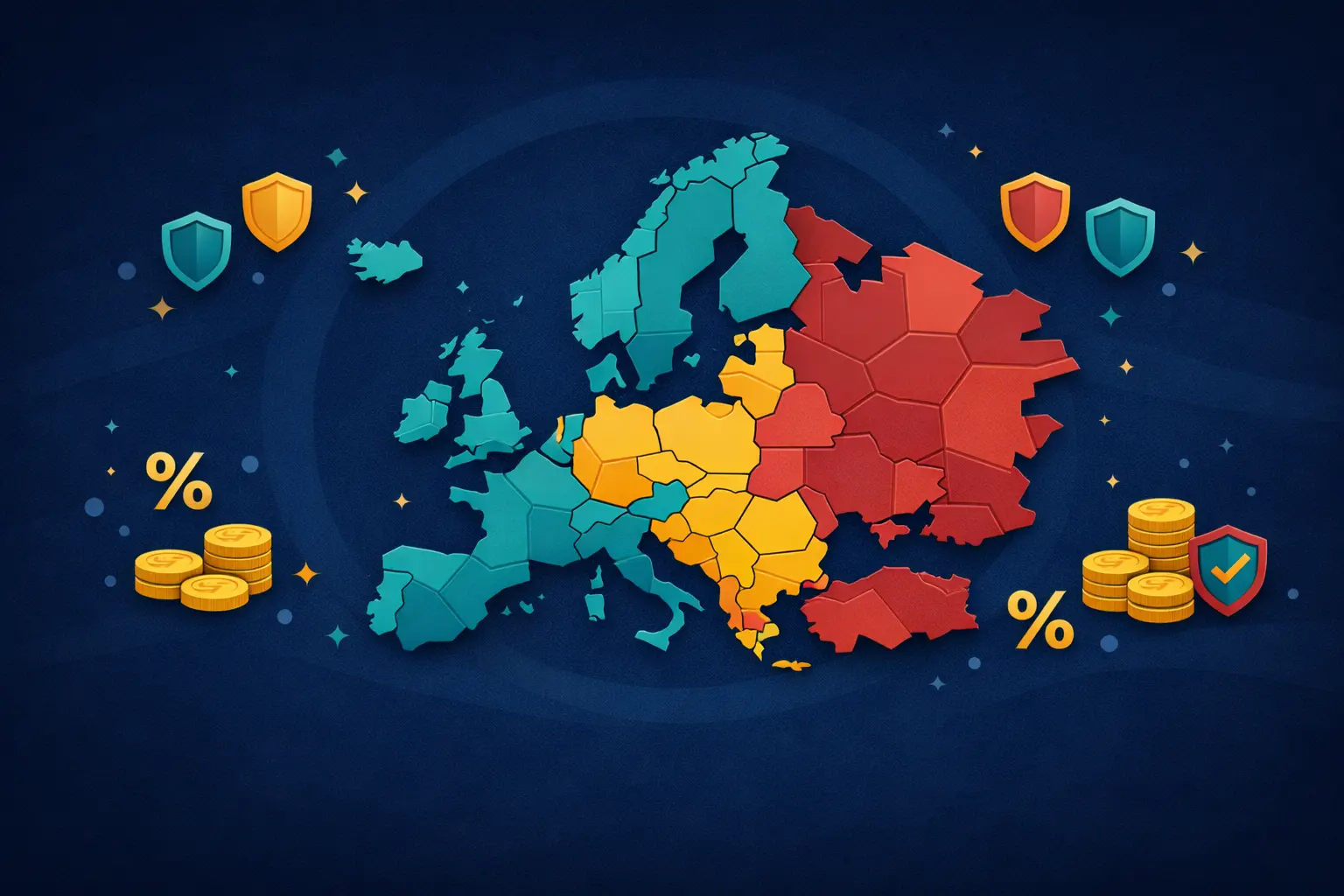
One of the most common questions players have is whether they need to pay tax on their casino winnings. The answer depends entirely on where you live and sometimes on where the casino is licensed. Some European countries do not tax gambling winnings at all while others take a serious cut. A few countries sit somewhere in between with rules that change depending on the operator you play at.
This guide covers 17 European countries and explains the actual rules for each one. No vague generalisations. Just the specific rates, thresholds and conditions that apply to recreational players in 2026.
🟢 Countries Where Gambling Winnings Are Tax-Free
These countries do not tax gambling winnings for recreational players. If you play casually and gambling is not your primary source of income you keep everything you win.
United Kingdom
The UK does not tax gambling winnings at all. The entire tax burden sits on the operators through the Remote Gaming Duty which was recently increased to 40% from April 2026. Whether you play at a UK-licensed casino or an offshore site your winnings are yours. The only theoretical exception is if HMRC determines that someone is running gambling as a structured business but this is extremely rare and would require evidence of systematic professional activity.
Belgium
Recreational players in Belgium pay no tax on gambling winnings from licensed platforms. The Belgian Gaming Commission has confirmed this directly. Professional gamblers who treat it as their primary income must declare winnings as professional income. Winnings from unlicensed sites technically fall outside the tax-free rules so sticking with licensed operators is the safer choice.
Austria
Austria does not tax gambling winnings for recreational players on EEA-licensed platforms. If you are playing at casinos licensed within the European Economic Area your winnings are tax-free. Professional gamblers or players with large consistent winnings from non-EEA operators may have their activity reclassified as taxable income. For most casual players this is not a concern.
Malta
Player winnings in Malta are completely exempt from taxation as long as gambling is not deemed a trade or profession. This applies to both residents and non-residents using MGA-licensed operators. Given that Malta is the licensing hub for a large share of European online casinos this is worth knowing.
Portugal
Recreational gambling winnings in Portugal are tax-free regardless of the amount. The operator pays a 25% GGR tax but players themselves owe nothing. This applies to play on SRIJ-licensed platforms. As with most countries on this list if gambling becomes your primary profession the tax authority may take a different view.
Estonia
All winnings from Estonian-licensed gambling are exempt from tax. Estonia has become known as a favourable jurisdiction for poker players partly because of this. The gambling tax on operators was recently reduced from 6% to 4% for remote gambling which may encourage more licensed operators to enter the market.
Germany (With a Caveat)
Germany does not directly tax player winnings. However there is a 5.3% turnover tax on stakes for sports betting, online slots and online poker. This is technically levied on the operator but it effectively reduces player returns since many operators pass the cost on through adjusted odds or reduced payouts. You will not see a line item on your tax return for gambling winnings but the stake tax means you are indirectly paying more for every bet you place win or lose.
🟡 Countries Where It Depends on the Operator
In these countries your tax liability depends on where the casino is licensed. Play at a domestically licensed or EU/EEA-licensed site and your winnings are tax-free. Play at an unlicensed or non-EEA site and you could owe significant tax. This distinction catches many players off guard.
Sweden
Winnings from Swedish-licensed casinos and any casino licensed within the EU/EEA are completely tax-free. Winnings from casinos licensed outside the EU are taxed at 30% as income from capital. This is a flat rate with no threshold. If you are a Swedish player this is one of the strongest reasons to stick with licensed operators.
Finland
Finland follows a similar model to Sweden. Winnings from EEA-licensed operators are tax-free under EU free movement of services principles. Winnings from non-EEA casinos must be reported as other income and are subject to progressive income tax rates which vary depending on your total income. The critical problem is that losses cannot be deducted from taxable winnings. A player could finish the year down overall but still owe tax on their gross winning sessions. We covered this in detail in our Finland gambling and poker tax guide. Finland is also in the middle of a major gambling reform that will introduce a licensing system by 2027 which may change these rules. Finnish players looking for EEA-licensed platforms can see our online casinos in Finland guide for current options.
Denmark
Winnings from Danish-licensed operators are tax-free. Winnings from unlicensed operators are treated as personal income and taxed at standard Danish income tax rates which can reach up to 62%. That is one of the highest potential rates in Europe. Denmark has one of the most well-regulated markets so there is no shortage of licensed options but players using offshore sites face serious tax exposure.
Norway
Norway has a threshold-based system. Single winnings of NOK 10,000 or less are tax-free. Amounts exceeding NOK 10,000 per game or event are taxed at 22%. Winnings from Norsk Tipping and Norsk Rikstoto are always exempt. Winnings from EEA-based operators with comparable public oversight are also exempt. The threshold applies per individual game or event not as an annual total. Professional gamblers are taxed as self-employed.
🔴 Countries That Tax Gambling Winnings
These countries apply direct taxes on player winnings. The rates and thresholds vary significantly.
Netherlands
The Netherlands has one of the highest gambling tax rates in Europe. The kansspelbelasting was 30.5% in 2024, increased to 34.2% in 2025 and will rise to 37.8% from January 2026. Winnings of EUR 449 or less are exempt. For KSA-licensed operators the tax is withheld automatically at the source. For unlicensed operators players must self-report. If you are playing from the Netherlands this tax significantly impacts the value of any casino bonus you claim.
Spain
Non-lottery gambling winnings in Spain must be declared in your annual income tax return at general progressive rates. The good news is that losses can offset winnings within the same tax year but only up to the amount of winnings. If your net gambling profits do not exceed EUR 1,000 and it is your only income there is no filing obligation. Lottery winnings follow different rules with the first EUR 40,000 exempt and the rest taxed at a flat 20%.
France
France is an interesting case. As a general principle gambling gains are not subject to income tax. However casino winnings exceeding EUR 1,500 are subject to a 12% levy that the casino collects directly. Professional poker players whose income depends on skill and strategy must file their winnings as non-commercial profits subject to standard income tax rates. For casual online casino players most winnings fall under the general tax-free principle.
Italy
Italy applies a 20% flat rate on net winnings from online poker, casino games and slots. Winnings under EUR 1,000 per year are typically exempt from reporting. The rate is straightforward compared to some other countries but 20% is still a meaningful reduction in your actual returns especially on larger wins.
Czech Republic
The Czech Republic taxes gambling winnings at 15% on net gains exceeding CZK 50,000 per game type annually. This threshold was reduced significantly from CZK 1,000,000 in 2024 so many more players are now affected. Each game type is assessed separately which means your poker winnings and slot winnings have independent thresholds. For lotteries operators withhold the tax automatically.
Poland
Poland applies a 10% tax on gambling winnings. A proposal to increase this to 15% was vetoed by the President in December 2025 so the rate remains at 10% for now. Single prizes below approximately EUR 520 are exempt. The tax is collected at source by the operator for games organised in Poland so players do not need to declare it separately.
Latvia
Latvia exempts the first EUR 3,000 of gambling winnings per year. Amounts above that threshold are subject to progressive personal income tax rates. The threshold is relatively generous for casual players but regular winners will pay tax on anything above it.
Lithuania
Gambling winnings in Lithuania are treated as taxable personal income at the standard 15% rate. The operator tax of 22% GGR is separate and does not reduce the player's tax obligation. Among the Baltic states Lithuania has the least favourable tax treatment for players compared to Estonia's fully tax-free approach.
📋 Quick Reference Table
| Country | Tax-Free? | Rate | Key Condition |
|---|---|---|---|
| UK | Yes | 0% | Always tax-free |
| Belgium | Yes | 0% | Licensed platforms |
| Austria | Yes | 0% | EEA-licensed operators |
| Malta | Yes | 0% | Not professional activity |
| Portugal | Yes | 0% | Recreational players |
| Estonia | Yes | 0% | Estonian-licensed |
| Germany | Effectively | 0% (5.3% stake tax) | Stake tax on operators |
| Sweden | Conditional | 0% EU / 30% non-EU | Depends on licence |
| Finland | Conditional | 0% EEA / progressive | Depends on licence |
| Denmark | Conditional | 0% licensed / up to 62% | Licensed = free |
| Norway | Conditional | 0% under NOK 10k / 22% | Per-game threshold |
| France | Mostly | 12% casino wins over EUR 1,500 | General principle tax-free |
| Netherlands | No | 37.8% (2026) | Above EUR 449 |
| Spain | No | Progressive | Losses offset winnings |
| Italy | No | 20% | EUR 1,000 exemption |
| Czech Republic | No | 15% | Above CZK 50,000 |
| Poland | No | 10% | ~EUR 520 exemption |
| Latvia | No | Progressive | EUR 3,000 annual exemption |
| Lithuania | No | 15% | Standard income tax |
🧠 What This Means for Players
The biggest takeaway is that where you play matters almost as much as where you live. In countries like Sweden, Finland and Denmark the difference between playing at a licensed versus unlicensed casino is the difference between keeping all your winnings and losing up to 62% of them. That alone is a stronger argument for sticking with licensed casinos than any bonus offer could ever be.
For players in high-tax countries like the Netherlands the tax on winnings changes the math on every bonus you claim. A wagering requirement that looks clearable at face value becomes much harder when 37.8% of your winnings disappear before you can withdraw. Use our bonus calculator to see how tax affects the real value of an offer.
If you are in a tax-free country you have a genuine advantage. Your effective RTP is higher because you keep every cent of every win. That compounds over time especially if you play with cashback or non-sticky bonuses where the returns are more predictable.
One final note. Nearly every tax-free country has an exception for professional gamblers. If gambling is your primary income source the tax authority may reclassify your winnings as business income regardless of the general rules. This guide covers recreational players. If you are a professional or semi-professional player consult a tax advisor in your jurisdiction.