How to Play Blackjack
Blackjack, also known as 21, is a card game where you compete against the dealer. The goal is simple: get a hand total closer to 21 than the dealer without going over (busting). Unlike poker, you do not compete against other players at the table.
- Place your bet before any cards are dealt. Each table has minimum and maximum bet limits.
- Receive two cards face up. The dealer gets one card face up (the upcard) and one face down (the hole card).
- Make your decision: Hit, Stand, Double Down, Split, or Surrender based on your hand and the dealer's upcard.
- Dealer plays after all players have acted. The dealer must hit on 16 or less and stand on 17 or more (rules vary by table).
- Compare hands. Closest to 21 wins. If you bust, you lose regardless of the dealer's hand. Ties (pushes) return your bet.
Card Values
Understanding card values is the foundation of blackjack. Every decision you make depends on knowing the value of your hand.
Hand Actions Explained
After receiving your initial two cards, you choose from the following actions. The correct choice depends on your hand total and the dealer's upcard — this is what basic strategy tells you.
Hit (H)
Take another card. You can hit as many times as you want until you stand or bust (exceed 21). Hit when your hand total is weak and the dealer shows a strong card.
Stand (S)
Keep your current hand and end your turn. Stand when your hand total is strong enough that taking another card would be too risky.
Double Down (D)
Double your original bet and receive exactly one more card. This is a powerful move when you have a strong starting hand (like 10 or 11) and the dealer shows a weak upcard. You sacrifice the ability to hit again for a bigger potential payout.
Split (P)
When dealt a pair (two cards of equal value), you can split them into two separate hands, each with its own bet equal to your original wager. Each hand is then played independently. Always split Aces and 8s; never split 10s or 5s.
Surrender (R)
Give up half your bet and forfeit the hand. This option is not available at all tables, but when offered, it is the correct play in certain situations (e.g., hard 16 vs dealer's 9, 10, or Ace). Surrendering saves money in the long run on hands that are statistically very likely to lose.
Basic Strategy Chart
This is the complete basic strategy chart for standard blackjack (4-8 decks, dealer stands on soft 17). Following this chart perfectly reduces the house edge to approximately 0.5%. Save or print it for reference when you play.
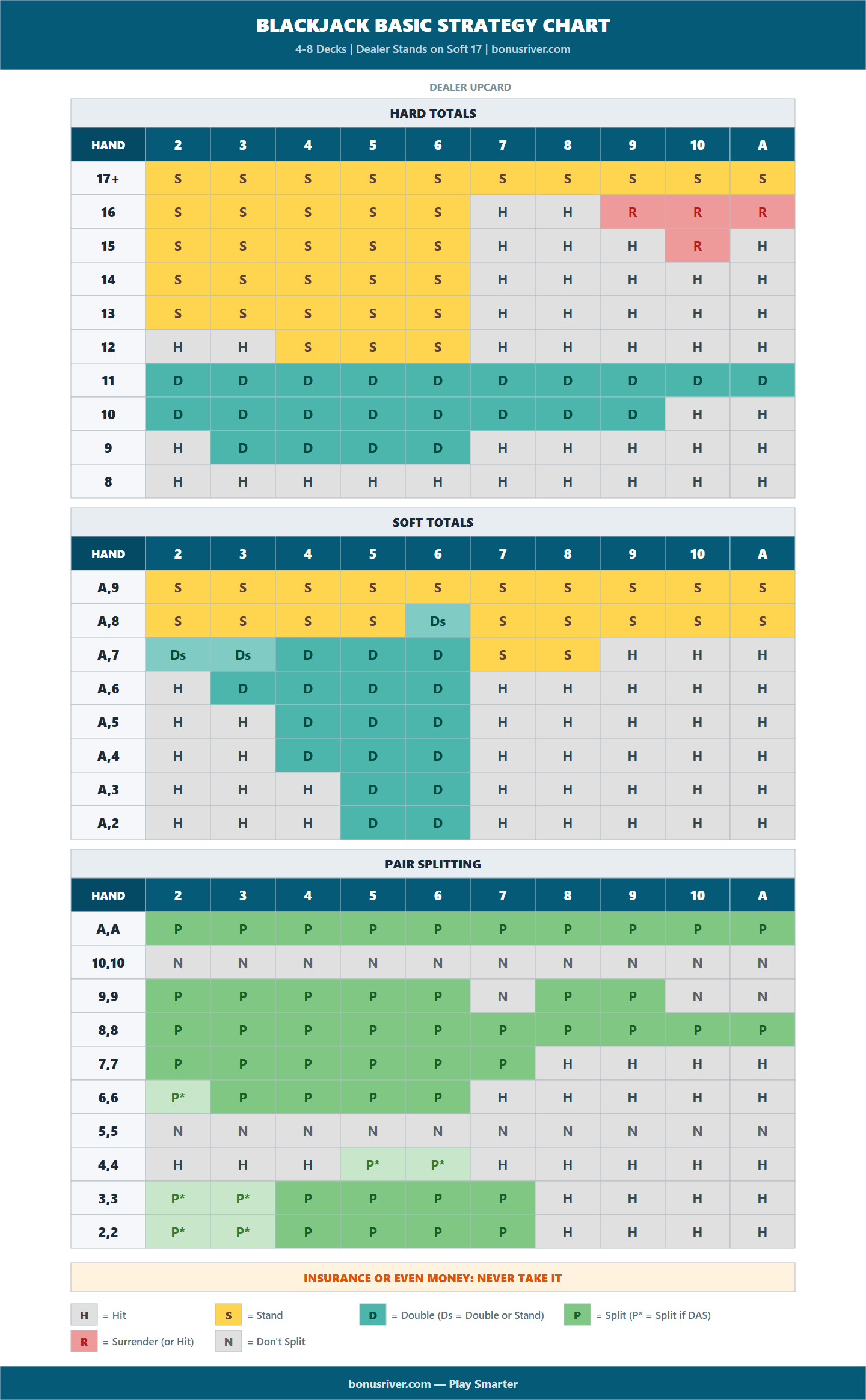
R = Surrender if available, otherwise Hit. Ds = Double if allowed, otherwise Stand. P* = Split if Double After Split (DAS) is allowed, otherwise Hit. N = Don't split.
House Edge & RTP
The house edge in blackjack depends on the specific rules at your table and how well you play. With perfect basic strategy on a standard game, the house edge is approximately 0.5%, making it one of the best bets in any casino.
This means for every $100 you wager over time, the casino expects to keep about $0.50. Compare this to slot machines (2-15%) or American roulette (5.26%), and it is clear why blackjack is the preferred game for strategic players.
Rule Variations That Affect House Edge
- 3:2 vs 6:5 blackjack payout: A 6:5 payout adds approximately 1.4% to the house edge. This is the single biggest factor — always play 3:2 tables.
- Dealer hits vs stands on soft 17: Dealer hitting soft 17 adds about 0.2% to the house edge.
- Number of decks: Fewer decks slightly favor the player. Single deck has the lowest edge, but is rare online.
- Double after split (DAS): Being allowed to double after splitting reduces the house edge by about 0.14%.
- Surrender available: Late surrender reduces the house edge by about 0.08%.
Popular Blackjack Variants
While the core rules remain the same, different blackjack variants offer unique twists that affect strategy and house edge. Here are the most popular versions you will find at online casinos.
Classic Blackjack
Standard rules, 4-8 decks, dealer stands on S17, 3:2 payout. The baseline game with the lowest house edge when played with basic strategy.
European Blackjack
Dealer only receives one card initially (no hole card). Typically played with 2 decks. Slightly different strategy since the dealer does not check for blackjack upfront.
Vegas Strip Blackjack
4-deck game, dealer stands on all 17s, double after split allowed, can split up to 4 hands. One of the most player-friendly rule sets available.
Atlantic City Blackjack
8-deck game with late surrender allowed. Dealer stands on S17, double after split permitted. The surrender option makes this variant strategically interesting.
Multi-Hand Blackjack
Play 3-5 hands simultaneously against the same dealer. Same rules as classic blackjack but with more action per round. Requires a larger bankroll.
Live Dealer Blackjack
Real cards, real dealer, streamed in real-time. Combines online convenience with authentic casino atmosphere. Available in standard, VIP, and speed formats.
Expert Tips for Blackjack Players
- Learn basic strategy first. Memorize the charts above or keep them handy. Perfect strategy play is the single most important thing you can do to improve your results.
- Always choose 3:2 tables. The difference between 3:2 and 6:5 blackjack payouts is massive — it adds nearly 1.4% to the house edge. This is non-negotiable.
- Never take insurance. Insurance is a side bet with a house edge of over 7%. It is a losing bet in the long run regardless of what the dealer shows.
- Always split Aces and 8s. Splitting Aces gives you two chances at 21. Splitting 8s turns a terrible hand (16) into two decent starting hands.
- Never split 10s or 5s. A pair of 10s is already 20 — one of the best hands possible. A pair of 5s is a hard 10, which is a great doubling opportunity.
- Manage your bankroll. Set a session budget and stick to it. A good rule is to have at least 20-30x your minimum bet as your session bankroll to handle normal variance.
- Start with low-stakes tables. If you are learning, play at the lowest minimum bet available. Many online casinos offer $0.50 or $1 minimum blackjack tables.
- Avoid side bets. Side bets (Perfect Pairs, 21+3, etc.) typically have house edges of 3-10%+, far worse than the main game. They are entertainment bets, not strategic ones.
- Take advantage of bonuses. Some casino bonuses can be used on blackjack, though wagering contributions are often reduced (typically 10-20% contribution). Check the terms before playing.
- Practice for free first. Most online casinos offer free demo blackjack games. Use them to practice basic strategy until the correct plays become automatic.